
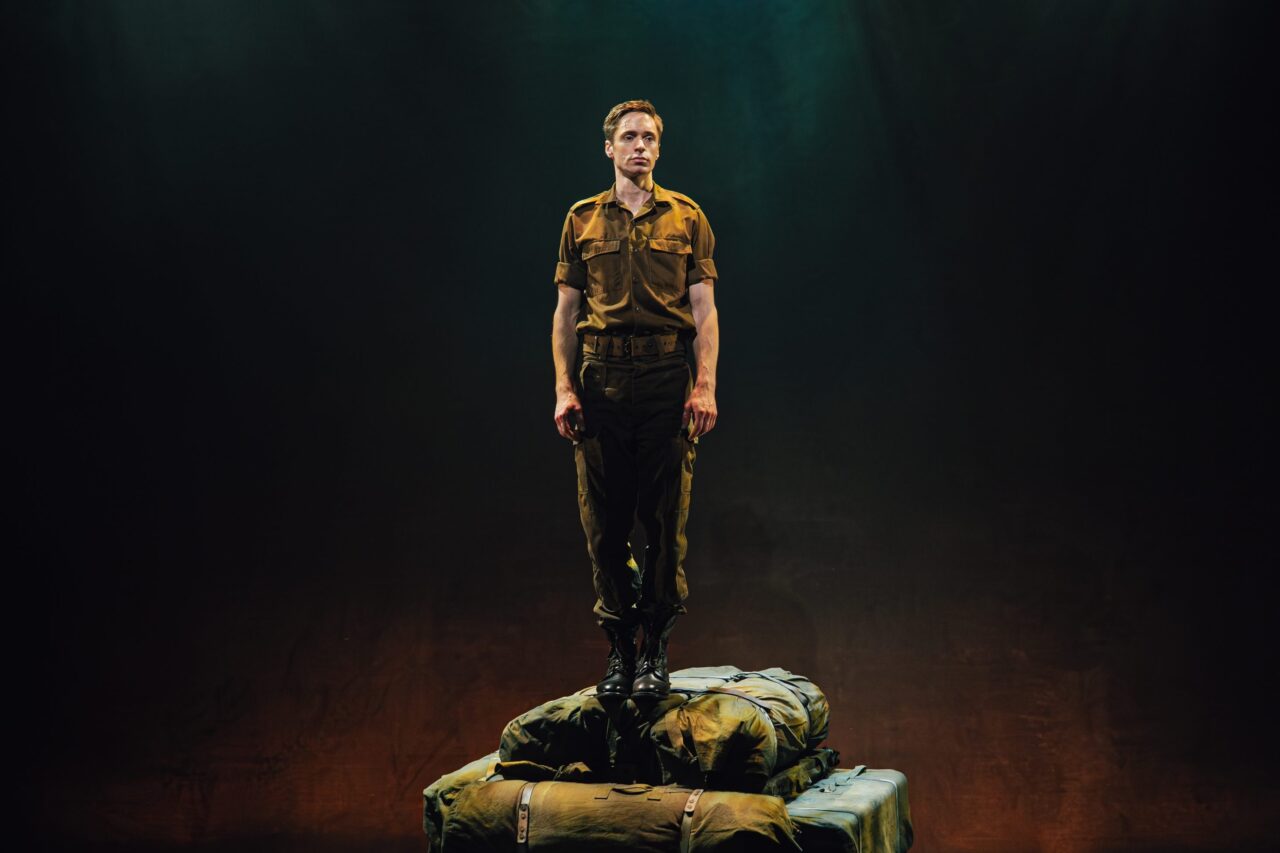
RUNNING at The Baxter’s Flipside until 27 September 2025, Moffie is that very special kind of theatre that takes you on a brutal, searing journey through utterly horrendous situations, while remaining utterly beautiful in its craft.
They were children.
Conscription in South Africa was established in 1967 and abolished in 1994 via a constitutional amendment. At its peak, conscription in South Africa consisted of two years of mandatory military service, followed by camps at intervals. Under apartheid, the call-up applied to all white men after completing their schooling or further studies.
Children.
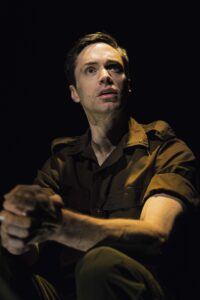 Award-winning actor David Viviers (The Tempest; Binnelanders) performs the role of Nicholas van der Swart, the closeted conscript whose harrowing journey lies at the heart of this tale. “These men trying to mould us into something we’re not… They must not be able to touch us…”
As if the trauma of fighting a war they did not understand nor agree with was not enough. As if the horrific training whereby they were ostensibly broken down to be rebuilt as unquestioning soldiers was not enough. Being ripped from family and loved ones with little or no choice, to become “property of the State”. No. There was also the fear of being exposed as a “moffie”, a pansy, a fairy, queer, a poof, fruit. The repercussions would be harsh and survival was not guaranteed whether true or not. A mere whisper of suspicion would suffice.
Based on the autobiographical novel by André Carl van der Merwe (based on diaries he kept as a teenager and during his compulsory national service), a movie was released in 2019, directed by Oliver Hermanus who explained in an interview with NPR: “The term moffie is a derogatory word in Afrikaans. It’s a weapon of shame used to criticise or humiliate men for a lack of masculinity. And it eventually sort of stretched itself into becoming a derogatory word to imply that you were gay. But in its sort of original function, its potency kind of related to heterosexual men, as well. So in the setting of our film, all these young boys who go to the army – being called a moffie is a thing you do not want to be called. But if, in fact, you are gay, you would sort of be – have – double potency. And, obviously, being gay during apartheid was illegal. So being called a moffie had a lot of risk attached to it.”
 Directed and produced by Greg Karvellas (Dear Evan Hansen; former artistic director of The Fugard Theatre), the book has been reimagined for the stage by award-winning playwright Philip Rademeyer (Stinkhout; Niggies), the stage production being based solely on the original literary work. Set, costume and lighting design is by Niall Griffin with sound design by Charl-Johan Lingenfelder. These latter two elements of the production, which frame Viviers on stage, are hugely instrumental in the exquisiteness of the production.
Nicholas describes his experiences, his fears, his hopes within the context of his military service, and he segues back and forth to his youth where we learn about his parents, and his beloved brother. Mom’s voice (Kate Normington) is off-stage, unseen, a mother powerless to protect her son; Viviers does the rest of the characters, mostly in English, some Afrikaans…particularly the heinous officers charged with humiliation of the conscripts, and the violence, oh the violence. It’s not restricted to combat situations.
They were children.
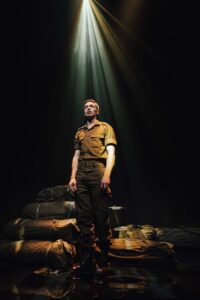
Griffin’s lighting keeps you sharply focused on Nicholas, with effects employed with restraint where necessary. The set is a pile of army kit bags, “symbolising the baggage of war and identity he carries. Every moment is charged with emotion, drawing spectators into a soldier’s internal battle in a way that only live theatre can achieve,” says Karvellas. Lingenfelder’s contribution is described as a soundscape, there but not there, never intruding, always enhancing. Even the stamp of Nicholas’s boot on the ground when he stands to attention is considered and meaningful.
 As it says below, the trauma of those times continue. We remember, even memories we thought forgotten, the words that yank us into the past. The real shame was what was done to those children.
Presented by The Baxter in association with The Common Humanity Arts Trust, Moffie runs until 27 September 2025. Rated PG 16 for mature themes including bigotry, violence, sexual assault, child abuse, and suicide. Running time is 85 minutes (no interval). No late entry is allowed and if you need to excuse yourself for whatever reason, you will not be allowed back in. This is so as not to distract the actor or the audience, and I heartily approve.
Performances are at 7.30pm, with a matinee on Saturdays at 3.30pm and a special discounted matinee performance every Wednesday at 3pm from 10 September. Book at Webtickets. Ticket prices range from R150 to R240, including special discounts available for seniors and students.
On Tuesday, 9 September, there will be a post-performance discussion and audience Q&A with author André Carl van der Merwe and director Greg Karvellas. From page to stage, to screen – and now back to the stage – André Carl will reflect on the extraordinary journey of his story, providing a unique behind-the-scenes look at both the book and its theatrical adaptation.
About the play:
Moffie is set in 1979 against the backdrop of apartheid South Africa, when the South African government’s main concern is keeping Southern Africa free of communism, to protect the Afrikaner people, Christianity, and the free world. To do this, they need bodies, and 17-year-old Nicholas van der Swart is conscripted into the South African Defence Force. He finds himself in the dark heart of a regime that demands absolute conformity, brute masculinity, racism, and bigotry.
Facing the dread of being labelled a “moffie”—and the ever-present fear of exposure—Moffie is an exploration of toxic masculinity and trauma, highlighting how, 30 years into South Africa’s democracy, the emotional wounds inflicted during those turbulent times persist, offering a reflection on the lingering scars of the past and their influence on the present and future.
Viviers, a Fleur du Cap Theatre Award-winning actor, says, “It is a huge honour and responsibility to bring Nicholas’s journey to the South African stage. I remember coming across Van der Mewe’s book as a schoolboy and being deeply affected by it. I realised then that there was a lot I didn’t know about our country’s past. There were things that weren’t spoken about because it was easier not to. Moffie holds up a mirror to our past in a way that is honest, relentless and also beautifully fragile. I am really excited to share this story with audiences.”
This critically acclaimed, culture-shaking production invites South Africans to witness an extraordinary theatrical event that is as entertaining as it is enlightening—a homecoming for a story that, for too long, remained in the shadows.
PHOTO CREDIT: Daniel Rutland Manners
