
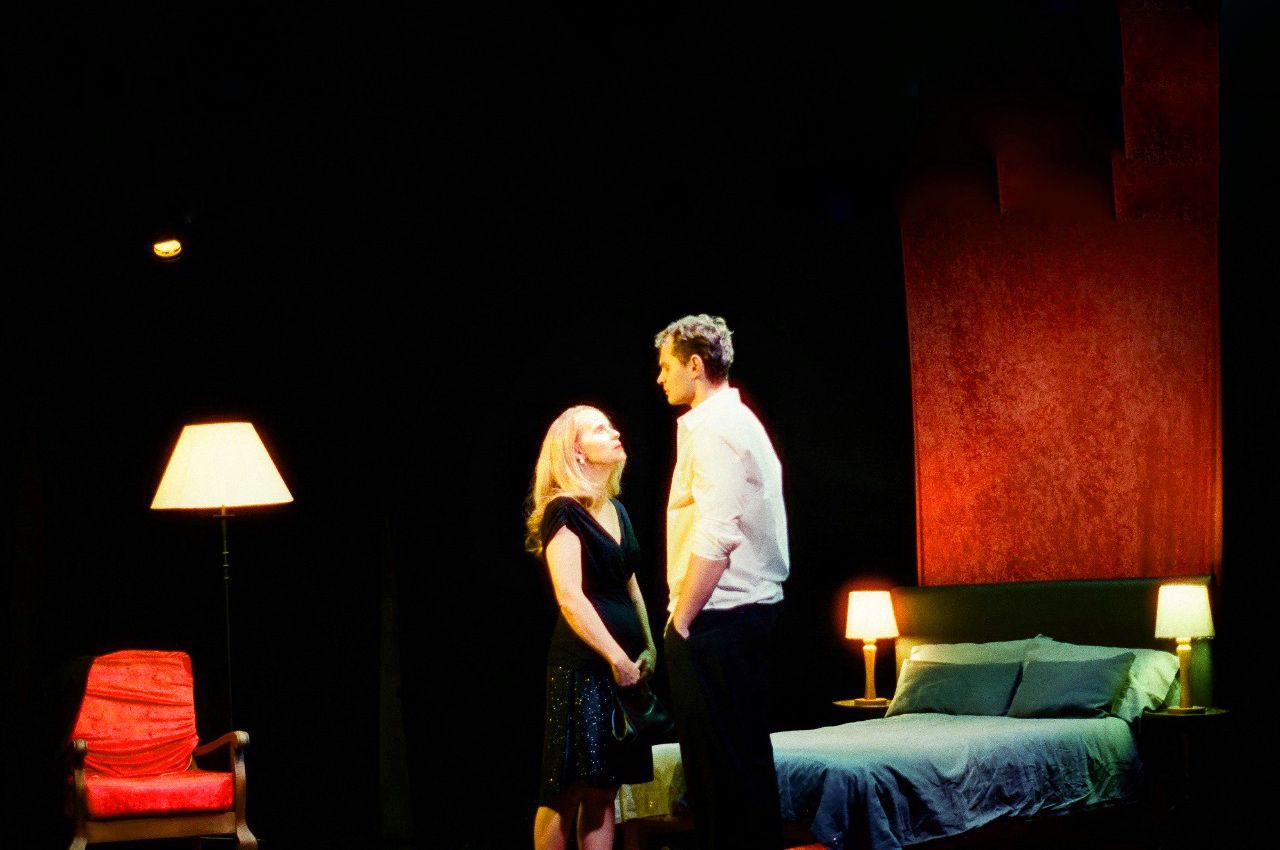
IF you are already familiar with Louis Viljoen’s work then you’ll have an idea of what you are in for with his latest play, Mrs Mitchell Comes To Town. It runs at The Baxter’s Masambe Theatre until 10 May. If you are a newcomer, well, then, consider yourself warned about this work of sheer beauty and horror.
Viljoen’s plays are dark, often shocking, compact yet with great depth, comprised of razor-sharp and brilliant dialogue, luminary intelligence – articulation of truths and thoughts we couldn’t put into words ourselves yet when we hear them they are at once obvious and relatable. And it all comes at you at a relentless pace, with new information being revealed by the minute. You need to hang on every line or get left behind. There’s no time to take notes, but you’ll wish you could recall it all, verbatim.
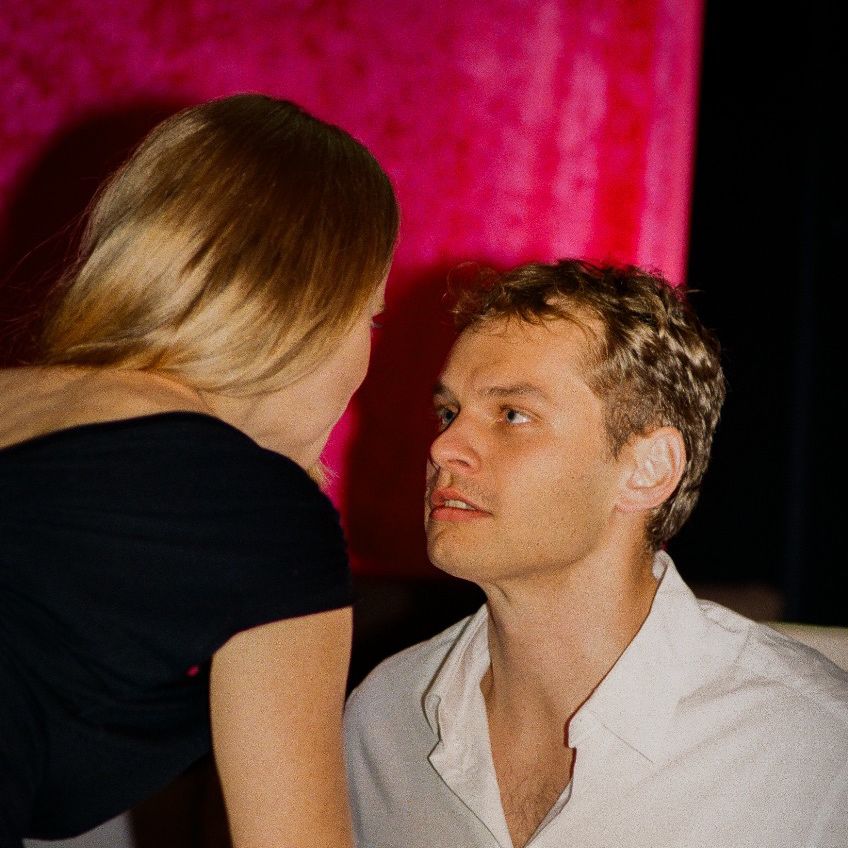 Good luck with that. You are not Jenny Stead or Aidan Scott, the actors who play Elsa (Mrs Mitchell) and Marcus, whose job it is to bring Viljoen’s vision to life, or death, to keep it all going from beginning to end. There is some breathing space between scenes, with a narrator filling in another part of the story integral to the one you are watching unfold, but you can’t relax as this takes place in pitch darkness, and although the voice (Nicholas Pauling) is calm and measured, the atmosphere is oppressive, serving to build the tension rather than alleviate it.
Mrs Mitchell Comes To Town takes place in a sparsely furnished hotel room, beginning with a not-accidental assignation – at least from Elsa’s side. Marcus is brought up to speed but there’s oh so much more he will discover whether he wants to or not. With this information he must decide if he will go ahead with what Elsa asks of him. There are, surprisingly almost, some light moments (black comedy is a thing) but the decidedly not funny yet perfect final scene drew some nervous titters. “Sometimes people don’t know how to react to things so they laugh inappropriately as a reflex,” said my friend, which is a fair point. At least there are feelings, and if you walk out unmoved, not discussing what you’ve just seen barely before you are out the door, then you haven’t been paying attention.
 Much like you settle into the rhythm of Shakespeare’s language and how it is spoken, so too with Viljoen’s. I asked him about it and he said, “I’ve never thought of it in terms of a specific style. I think it’s about being economical and cutting off all the fat so that we can tell the story as directly and honestly as possible. Business for business’s sake distracts from the focus of the story. So we apply that to all aspects of the production.”
By this, Viljoen means in terms of actions on stage: people doing things like playing with props, gesturing unnecessarily, moving without intent, everything that people do to “show” how hard they’re acting. “This is called business, usually employed to make it seem like ‘real’ life or give characters the appearance of depth,” he said. “This goes for directors as well, who will ask actors to do that, as well as adding things to their shows to show how much the show is directed.”
He also wrote in his pre opening night reminder email “the bars in the Masambe and the Baxter main foyer will be open; pre- and post-drinks are highly encouraged.” Take that as you will.
The tiny Masambe is the perfect venue for a production like this; sit in the front row if you dare – you will feel as if you are onstage, in the room. I find this intimacy enhancing but withheld what should have been my standing ovation, which would have put me almost at eye level with Stead and Scott and that would have just been weird.
Are you brave enough to be challenged? Book at Webtickets.
PHOTO CREDIT: Skye Russell (shot on film)
